


Introduction
Most organizations think MFA and rate limiting are enough to stop credential stuffing. They aren’t. Attackers have adapted, and the controls that worked five years ago are now routinely bypassed using residential proxy networks, low-and-slow automation, and real-time session token interception.
Preventing credential stuffing attacks requires a layered defense: behavioral bot detection, adaptive throttling, breach credential monitoring, and post-authentication session integrity controls working together. No single control closes the gap.
This guide covers six concrete controls security teams use to detect and block credential stuffing campaigns, the bypass techniques that defeat legacy defenses, and the operational metrics that tell you whether your current stack is actually working.
What Is a Credential Stuffing Attack? (And What It Isn’t)
Credential stuffing isn’t about guessing passwords. It’s about using passwords that are already known to work.
Attackers take breached username/password pairs and automate their testing at scale against live login endpoints. The attack exploits one stubborn behavior: credential reuse. According to Verizon’s 2025 DBIR research, only 49% of a compromised user’s passwords across different services are distinct. A single breach can open doors across dozens of unrelated platforms. The supply of raw material is vast: the 2025 DBIR found that 88% of breaches in the Basic Web Application Attacks pattern involved stolen credentials.
Three attack types get conflated here, and the distinctions matter operationally:
- Brute force generates password guesses with no prior context. It’s computationally expensive and increasingly ineffective against modern lockout policies.
- Credential stuffing tests verified credential pairs from breach databases against login endpoints. Imperva puts the success rate at approximately 0.1% per credential pair. At the scale attackers operate, that converts to thousands of compromised accounts per campaign.
- Phishing harvests credentials directly from victims. It’s an upstream attack vector, not a login-layer abuse technique.
The distinction isn’t academic. Brute force triggers lockouts. Phishing targets individuals. Credential stuffing is a volume game run entirely by bots, designed to stay below detection thresholds while systematically validating stolen credentials at scale.
A successful stuffing attempt doesn’t end at login. It’s the entry point to account takeover fraud, where the real financial damage begins.
Why Traditional Controls Fail Against Modern Credential Stuffing Campaigns
Here’s the uncomfortable truth: attackers aren’t breaking your defenses. They’re walking around them.
The controls most organizations rely on, including password policies, CAPTCHA, IP blocking, rate limiting, and MFA, were designed for a different threat model. Modern credential stuffing campaigns are engineered to bypass each one. That doesn’t make these controls useless. It makes them table stakes that sophisticated bot operators have already priced into their attack tooling.
- Password strength requirements are irrelevant against credential stuffing. Attackers aren’t guessing passwords. They’re testing verified pairs from prior breaches. A 20-character password offers zero protection if it was reused on a breached site.
- Basic CAPTCHA has been neutralized at scale. Modern bot frameworks integrate with CAPTCHA-solving services like CapMonster and Anti-Captcha, using AI solvers and human click farms to defeat challenges for fractions of a cent per solve. Standard CAPTCHA creates more friction for legitimate users than it stops automated abuse.
- IP blocking and reputation lists can’t keep pace with residential proxy infrastructure. According to GreyNoise research cited by BleepingComputer, 78% of malicious sessions routed through residential proxies are invisible to IP reputation feeds. These proxies rotate through IPs sourced from compromised consumer devices across 683 internet service providers, with 89.7% of residential IPs active in attacks for under a month before cycling out. No blocklist can keep up.
- Static rate limiting is equally blind to distributed infrastructure. A campaign testing 10 million credentials across 500,000 IPs generates roughly 20 attempts per IP. That’s well below any static threshold. The attack runs at industrial scale while remaining invisible at the per-IP level.
- Single-layer MFA raises the cost of account takeover, but it doesn’t stop the testing phase. As F5 Labs documents in their 2025 Advanced Persistent Bots Report, attackers still use credential stuffing to enumerate valid accounts, identify MFA-fatigue targets, and harvest session tokens via adversary-in-the-middle proxies like Evilginx2. MFA stops the final login step for some users. It doesn’t disrupt the bot campaign running against your infrastructure.
This isn’t a failure of any single control. It’s a failure of the underlying model: static, perimeter-level defenses applied to a dynamic, distributed attack. The gap isn’t in your controls. It’s in your visibility.
The Bypass Techniques Attackers Use at Scale
Modern credential stuffing operators don’t knock on your front door. They slip through a thousand windows simultaneously, using infrastructure purpose-built to look exactly like your legitimate users.

- Residential proxy networks. Commercial proxy-as-a-service providers sell access to millions of rotating residential IP addresses sourced from real consumer devices across every geography. Each login attempt appears to originate from a different household, making IP blocklists and geo-fencing functionally useless. The F5 2025 Advanced Persistent Bots Report notes that residential proxies are now a standard component of persistent bot campaigns.
- Headless browser automation and behavioral mimicry. Tools like Puppeteer and Playwright simulate realistic browser fingerprints, mouse movement patterns, and typing cadence. They’re not just automating clicks. They’re impersonating the micro-behaviors your basic heuristics were trained to trust.
- Credential combo list aggregation. Breach data is continuously aggregated, deduplicated, and sold on dark web marketplaces. SpyCloud’s 2025 Annual Identity Exposure Report found that 91% of organizations suffered an identity-related incident in the past year, nearly double the prior year’s figure, with total recaptured identity records growing 22% to 53.3 billion distinct records.
- Distributed timing and low-and-slow attack patterns. Campaigns deliberately throttle request rates and introduce randomized delays between attempts to stay below velocity thresholds. Static rate limiting never fires. The attack runs for days or weeks undetected.
- API endpoint targeting. Attackers increasingly route stuffing campaigns through mobile API login endpoints rather than web login forms. The F5 report confirms that mobile API endpoints see higher automation rates pre-mitigation than web endpoints, precisely because many organizations apply weaker bot controls at the API layer. If your detection stack is web-first, your API is the open side door.
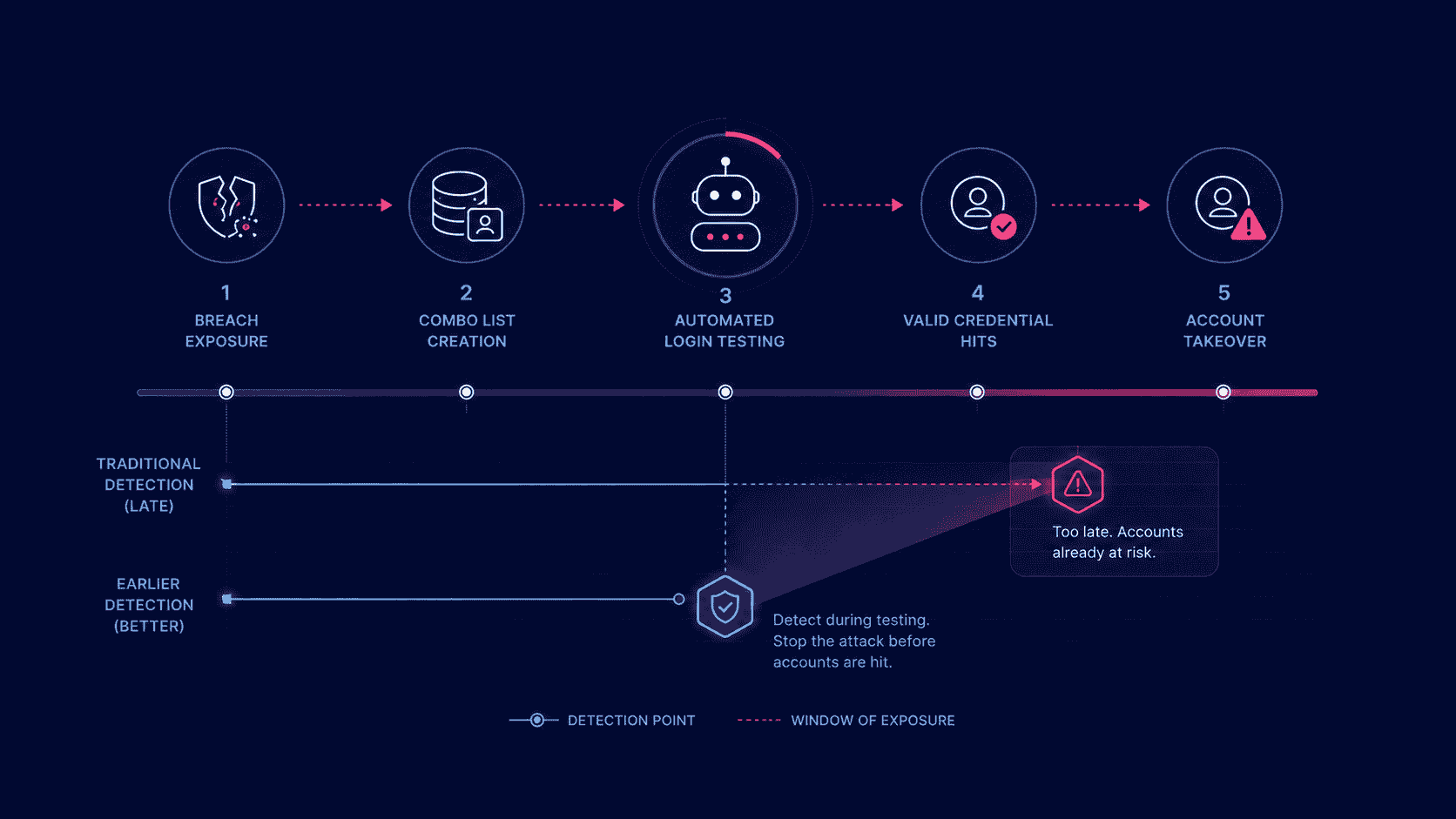
How Credential Stuffing Leads to Account Takeover
Credential stuffing doesn’t end at the login page. It ends in your customer’s bank account, loyalty wallet, or frequent flyer balance, and the path between those two points is faster and more automated than most teams expect.
- Stage 1: Breach to combo list
Harvested credential pairs are cleaned, deduplicated, and packaged into combo lists within days, sometimes hours, of a breach becoming known. Attackers don’t need to breach your systems. They just need someone else’s breach to target yours.
- Stage 2: Bot campaign setup
The attacker loads the combo list into a credential stuffing tool, such as OpenBullet, SilverBullet, or a custom framework, and configures it with your login endpoint’s request structure and proxy rotation settings. Setup takes hours, not days.
- Stage 3: Account testing at scale
The bot campaign fires thousands to tens of thousands of login attempts per hour, distributed across rotating IPs to stay under detection thresholds. The Verizon 2025 Data Breach Investigations Report confirms that stolen credentials are involved in 88% of Basic Web Application Attack breaches, reflecting how industrialized this testing phase has become.
- Stage 4: Valid credential identification
Only a fraction of attempts succeed. Imperva research puts the typical success rate at around 0.1%. Against a combo list of 10 million pairs, that’s 10,000 confirmed account accesses. The attacker now has a verified hit list.
- Stage 5: Account compromise and downstream fraud
The attack pivots to account takeover. In financial services, that means unauthorized wire transfers or new account fraud. In eCommerce, it’s stored payment abuse or loyalty point drain. In airlines and hospitality, frequent flyer miles and accommodation accounts are prime targets.
The window between Stage 3 and Stage 5 is where prevention either works or fails. Most static controls don’t catch the campaign until accounts are already compromised.
Related resource: Credential stuffing is one path into ATO. Read Memcyco’s full guide to account takeover fraud prevention to see how phishing exposure, credential misuse, device risk, and early intervention fit into the wider attack chain.
How to Prevent Credential Stuffing Attacks: 6 Layered Controls
Step 1: Enforce Multi-Factor Authentication Strategically
MFA is the right starting point. But treating it as a credential stuffing solution misunderstands what it actually does.
MFA’s real value is raising the cost of account compromise. When an attacker authenticates with a valid stuffed credential pair, a properly enrolled MFA challenge blocks the final step: account access. For enrolled users, that’s a meaningful barrier. NIST SP 800-63B recommends phishing-resistant authenticators, specifically FIDO2/WebAuthn and passkeys, as the strongest form, and requires AAL2 applications to offer phishing-resistant options.
Here’s what MFA doesn’t do: stop the testing phase.
Attackers running credential stuffing campaigns don’t care about your MFA policy during enumeration. They’re probing your login endpoint at scale, identifying which accounts exist, which credentials are valid, and which accounts aren’t MFA-enrolled. Those unenrolled accounts become the primary targets. According to Okta’s Secure Sign-In Trends Report 2025, workforce MFA adoption has reached 70%. That means nearly one in three users has no MFA protection at all.
Enrollment gaps aren’t the only exposure. MFA itself can be bypassed:
- MitM proxy frameworks like Evilginx2 intercept session tokens in real time, rendering OTP-based MFA ineffective
- Push bombing (MFA fatigue) overwhelms users with notifications until they approve a fraudulent request
- SIM swapping undermines SMS OTP entirely
The implementation guidance is specific: prioritize FIDO2/passkeys over SMS OTP, enforce adaptive step-up MFA for anomalous signals (new device, unfamiliar geography, off-hours access), and treat MFA bypass attempts as detection signals in their own right.
MFA reduces successful account takeovers for enrolled users. It does not reduce attack volume at the login endpoint. That distinction matters when you’re building a prevention architecture.
Step 2: Deploy Advanced Bot Detection and Behavioral Analysis
A bot running a credential stuffing campaign doesn’t look like a bot, until you examine the signals most login defenses never collect.
The core challenge is separating automated login traffic from legitimate users in real time, without adding friction that drives customers away. Static controls can’t do this. Behavioral detection can.
Modern bot detection platforms build a risk profile from multiple concurrent signals:
- Typing cadence and keystroke dynamics. Humans type with natural variability: inconsistent inter-key intervals, occasional corrections, realistic dwell times. Bots inject credentials instantaneously or with unnaturally uniform timing.
- Mouse movement and pointer trajectory. Human cursor paths are curved and hesitant. Bots frequently submit forms with no pointer movement, or trace geometrically straight paths no human produces.
- Request timing and inter-request intervals. Even when attackers randomize their campaigns, the statistical distribution of request timing deviates from human baseline traffic. Machine learning models trained on real login behavior detect these deviations at scale.
- Device fingerprinting. Browser fingerprint consistency, canvas rendering, WebGL output, font enumeration, and plugin profiles expose headless browsers and automation frameworks, even when they spoof user-agent strings.
- TLS fingerprinting (JA3/JA4). The TLS handshake characteristics of automated clients differ from real browsers at the network layer. JA4 fingerprinting provides a protocol-level signal that’s difficult to spoof without breaking the automation framework itself.
These signals combine into a per-attempt risk score, enabling real-time allow, challenge, or block decisions without interrupting legitimate users.
One critical operational point: bot detection is not a one-time deployment. F5 Labs’ 2025 Advanced Persistent Bots Report found that even across organizations with active bot mitigation, an average of 10.2% of all HTTP transactions were still bots. Attackers adapt continuously.
The common mistake is relying on a single behavioral signal. Sophisticated bots defeat individual checks. They struggle against multi-signal ensemble models that correlate five or six signals simultaneously, because mimicking all of them perfectly in real time is operationally expensive for attackers.
Step 3: Implement Intelligent Rate Limiting and Adaptive Throttling
Static rate limiting is a speed bump, not a barrier. Block after five failed attempts per IP per minute, and a distributed botnet simply spreads those attempts across thousands of IPs, each staying safely under your threshold. The attack continues. Your controls register nothing unusual.
Adaptive throttling works from a different premise. Instead of counting attempts per IP, it establishes baseline login velocity patterns across accounts, IP clusters, device fingerprints, and ASNs, then triggers graduated responses when those baselines break. Verizon’s 2025 DBIR research found that credential stuffing accounts for a median of 19% of all daily authentication attempts, rising to 25% at enterprise-scale organizations. A static rule won’t catch that.
Five controls make adaptive throttling effective:
- Per-account velocity monitoring. Flag accounts receiving login attempts from multiple distinct IPs within a short window, regardless of per-IP rate. This catches distributed campaigns targeting specific high-value accounts.
- ASN and hosting provider clustering. Legitimate users rarely authenticate from datacenter IP ranges or known proxy ASNs. Elevated failure rates from these sources warrant aggressive throttling or step-up challenges.
- Login failure ratio baselining. Establish your normal failure rate (typically 2-5% for legitimate traffic). Endpoint-level spikes above this baseline are a reliable early indicator of an active stuffing campaign.
- Adaptive CAPTCHA step-up. Rather than applying CAPTCHA universally and degrading UX, trigger challenges selectively based on risk score thresholds, as OWASP’s Credential Stuffing Prevention guidance recommends.
- Credential pair deduplication. Detect when the same username/password pair is tested across multiple sessions or accounts. This pattern is unique to stuffing campaigns and invisible to per-IP controls.
One critical implementation note: adaptive throttling requires a live feedback loop. Controls must update dynamically as attackers adjust their distribution patterns mid-campaign.
Adaptive throttling increases attacker cost and reduces campaign ROI. But it won’t catch sophisticated low-and-slow campaigns on its own. That’s where behavioral detection becomes essential.
Step 4: Monitor for Compromised Credentials and Breach Exposure
By the time an attacker tests a stolen credential against your login endpoint, you may already have the information needed to stop them. You just didn’t act on it first.
Credential intelligence feeds change that dynamic. Services like SpyCloud and Have I Been Pwned continuously ingest breached credential data from dark web sources, alerting organizations when their users’ credentials surface in breach databases. This turns breach exposure from a reactive discovery into a proactive intervention point. NIST SP 800-63B explicitly requires verifiers to check passwords against blocklists of compromised values, making this a compliance baseline, not just a best practice.
Put that intelligence to work with these controls:
- Proactive password reset workflows. When a credential pair appears in a breach feed, trigger a forced reset at next login. For high-risk accounts, trigger it immediately, before an attacker can test it.
- Credential reuse detection. Monitor for users who set new passwords matching previously breached values, not just their own prior passwords. This directly targets the reuse pattern that credential stuffing exploits.
- SIEM integration. Feed breach intelligence into your fraud or SIEM platform to correlate exposure events with login anomaly signals in real time, so a breach hit and a suspicious login attempt surface together, not in separate queues.
The critical limitation: breach intelligence feeds have latency. Fresh credentials from a new breach may be tested against your endpoints before they appear in any monitored database. That gap can be hours or days. This is why credential intelligence must layer with behavioral detection. It’s a powerful early-warning control, but it can’t stand alone.
Step 5: Use Session Integrity and Post-Authentication Anomaly Detection
A successful credential stuffing attempt doesn’t end at the login screen. It starts there.
Even with strong pre-authentication controls, some stuffing attempts will succeed, particularly against accounts not enrolled in MFA, or where session tokens are stolen via infostealer malware. According to MojoAuth Research, session hijacking increased 127% year-over-year in 2025 as attackers adapted to stronger login-layer defenses. Most fraud occurs within the first 24 hours after account takeover. That’s your detection window.
Session integrity monitoring closes it. Here’s what to instrument:
- Device consistency signals. Flag sessions where the device fingerprint at login doesn’t match the user’s established device history. A login from an unrecognized device in a new geography, following a period of inactivity, is a high-risk signal worth triggering step-up authentication.
- Geolocation anomalies. Impossible travel detection, a login from New York followed 10 minutes later by one from Singapore, is a reliable account takeover indicator. Also flag logins from known VPN exit nodes, Tor exit nodes, and datacenter IP ranges, which are common in bot-driven campaigns.
- Behavioral drift post-login. Legitimate users exhibit consistent post-login patterns: pages visited, transaction types, session duration. Sudden deviations, immediate navigation to payment settings, bulk loyalty point redemption, rapid data export, indicate compromise. OWASP’s Session Management guidance recommends treating anomalous post-login behavior as a re-authentication trigger.
- Session hijacking indicators. Monitor for session token reuse across multiple IPs, abnormal session lifetimes, and concurrent sessions from geographically disparate locations.
- Step-up re-authentication triggers. Define high-risk post-login actions, payment method changes, address updates, large transactions, that require re-authentication regardless of how the initial login was completed.
Post-login behavioral tools remain valuable, but they are late-stage safeguards. Memcyco strengthens the earlier layer by identifying suspicious credential, device, and login patterns before credential stuffing turns into account takeover.
Step 6: Correlate Login Signals Across All Channels
Attackers don’t see a boundary between your web login, mobile app, and partner API. Your detection stack probably does. That gap is what sophisticated campaigns exploit.
Modern credential stuffing operations test credentials across multiple endpoints simultaneously or in sequence. When a campaign hits a wall on your web login endpoint, it pivots to the mobile API. When the mobile API tightens up, it probes partner-facing authentication surfaces. Each channel is often monitored by a different team with different tooling, and the signals never meet. A credential pair that fails on the web and succeeds on the mobile API is a high-confidence ATO indicator. Siloed detection will never surface it.
Infosecurity Magazine reported a 40% increase in credential stuffing and ATO attempts targeting APIs in the first half of 2025 alone, with APIs now attracting 44% of advanced bot traffic. Financial services, telecoms, and travel were the primary targets.
Four things need to work together:
- Unified signal correlation: All login endpoints, web, mobile, and API, must feed into a single correlation layer. Per-channel monitoring creates seams. Attackers live in the seams.
- Cross-account pattern detection: A single device fingerprint or IP cluster attempting logins across hundreds of accounts is a campaign-level signal. Per-account monitoring misses it entirely.
- Partner API perimeter inclusion: Organizations that expose authentication functionality via partner APIs must include those endpoints in their monitoring scope. Less-protected surfaces get probed first.
- SIEM enrichment: Unified login signals should feed your SIEM for correlation against known malicious IPs, breach exposure events, and fraud alerts. Standard log data can’t provide this context alone. Purpose-built APIs for SIEM integration are designed to fill that gap.

The common mistake: treating mobile API security as a separate program from web application security. Attackers see one attack surface. Your detection architecture should too.
The Strategic Shift: From Login Defense to Automation Visibility
Most teams are solving the wrong problem.
The prevailing mental model treats credential stuffing prevention as an authentication-layer failure: strengthen the password policy, add MFA, block the offending IP. These are reasonable responses to a symptom. They don’t address the attack mechanism, which is automated account testing at scale, running continuously across distributed infrastructure designed to evade static controls.
The real prevention gap isn’t MFA adoption. It’s automation visibility.
- The detection timing problem
Most organizations discover a credential stuffing campaign after accounts are already compromised. By that point, the cost isn’t just the fraud loss. It’s the investigation, the reimbursement, the remediation, and the customer trust that doesn’t come back. According to the IBM 2025 Cost of a Data Breach Report, breaches initiated with stolen credentials carry a mean time to identify and contain of approximately 246 days. Eight months of exposure before the organization knows the attack succeeded.
The critical variable isn’t whether you can block a known attack. It’s how early in the attack chain you detect automated campaign activity. Catching bot-driven login traffic before any credential pair succeeds is categorically different from detecting a compromised account after the fact. One stops the campaign. The other starts the cleanup.
- Behavioral profiling as the detection primitive
Automation visibility requires continuous behavioral profiling of login traffic. That means establishing what legitimate human login behavior looks like for your specific application and user population, typing cadence, request timing, device fingerprint consistency, session flow, and then detecting statistical deviations that indicate bot activity.
This isn’t a one-time configuration. Attacker tooling evolves. Human-behavior emulation frameworks get more sophisticated. Behavioral profiling must adapt as attack techniques shift. It’s an ongoing operational capability, not a checkbox.
- The compounding value of early detection
Detecting a credential stuffing campaign at the bot-traffic stage, before any credential succeeds, enables campaign-level disruption. You block the attack infrastructure, not just the individual account. That’s the difference between stopping a wave and mopping up after it.
This model is operationally achievable. Memcyco delivers a 50% reduction in ATO incidents, up to 90% reduction in investigation time, and near-zero mean time to detection for live attacks. Those outcomes are only possible when detection happens early in the attack chain, not after compromise.
The shift from login defense to automation visibility isn’t a product decision. It’s a strategic one. The teams that make it stop reacting to fraud and start disrupting the campaigns that cause it.
Measuring Credential Stuffing Prevention Effectiveness
You can’t defend what you can’t measure. Most security teams have controls in place. But without operational metrics tied to specific thresholds, there’s no reliable way to know whether those controls are working or quietly failing.
Track these six KPIs in your weekly security operations cadence and feed them into your SIEM for real-time alerting.
| Metric | What It Measures | Healthy Baseline | Alert Threshold | Operational Response |
| Login failure rate | Ratio of failed to total login attempts per endpoint | 2-5% for legitimate traffic | >15-20% sustained spike | Trigger bot investigation; isolate affected endpoint |
| Bot-to-human traffic ratio at login | Proportion of login requests from automated clients | Trending downward as controls mature | Sector spikes up to 80% possible | Escalate behavioral detection rules; review proxy filtering |
| Credential reuse detection rate | % of login attempts using credentials in known breach databases | Low and stable | Rising rate, especially post-breach | Force password resets; notify affected accounts proactively |
| Account takeover incident rate | Confirmed ATO incidents per month | Declining month-over-month | Plateau or increase | Review detection gaps; audit post-login session signals |
| Time-to-detect automated login campaigns | Elapsed time from campaign start to detection | Minutes, not hours | >1 hour | Review alerting thresholds; assess behavioral signal coverage |
| MTTR to confirmed ATO | Time from ATO detection to account containment and remediation | Under 1 hour | >4 hours | Initiate incident response playbook; review triage workflows |
- A few notes on using these metrics effectively:
- Login failure rate is your earliest warning signal. Monitor it per endpoint, not just in aggregate. Attackers often target a single API login path while your aggregate rate looks normal.
- Bot-to-human ratio requires behavioral detection instrumentation to estimate accurately. According to F5 Labs’ 2025 Advanced Persistent Bots Report, bot traffic at login pages averages 20% across industries, with some sectors hitting 80%. If you’re not measuring this, you’re flying blind.
- Credential stuffing accounts for 19% of all daily authentication attempts at the median, according to Verizon’s 2025 DBIR research. In enterprise environments, that figure rises to 25%. Your credential reuse detection rate should reflect this baseline reality.
- Detection timing is the critical variable. Campaigns detected within the first hour cause dramatically less downstream fraud than those running undetected for 24+ hours. Reducing MTTR from 72 hours to under one hour is achievable, and it directly cuts ATO incident volume.
These aren’t vanity KPIs. Each one maps to a specific operational response. A metric that doesn’t trigger an action isn’t a metric. It’s noise.
Credential Stuffing Prevention: Common Mistakes to Avoid
Deploying controls isn’t the same as being protected. Most organizations have something in place and still get hit. Here’s where prevention breaks down in practice.
- 1. Treating MFA as a complete solution
MFA is essential, but it’s not a perimeter. According to Descope’s 2025 State of Customer Identity Study, only 10% of organizations offer MFA across all their applications. Unenrolled accounts remain fully exposed to automated login testing. Even enrolled accounts aren’t safe: adversary-in-the-middle (AiTM) attacks steal session tokens post-authentication, bypassing MFA entirely. MFA raises the cost of a successful stuffing attempt. It doesn’t stop the testing phase.
- 2. Applying static rate limits without adaptive baselines
Static thresholds are calibrated for average traffic. Distributed credential stuffing campaigns don’t look like average traffic. They spread login attempts across thousands of IPs, staying deliberately below fixed thresholds. Without dynamic baselining tied to per-account, per-device, or per-IP-cluster velocity, static rate limits create a false sense of security while attackers operate freely underneath them.
- 3. Siloing web and mobile API detection
Attackers don’t commit to a single channel. When web login endpoints tighten, campaigns pivot to mobile APIs or partner-facing endpoints. Organizations that monitor web traffic but leave mobile API login endpoints unmonitored are handing attackers a reliable fallback. Siloed detection doesn’t just create blind spots. It actively redirects attack volume to your least-defended surface.
- 4. Relying on IP reputation lists as a primary control
IP reputation lists are inherently reactive: they block known bad IPs, not unknown ones. Residential proxy networks defeat them entirely by routing attack traffic through legitimate consumer IP addresses with no prior reputation signal. OWASP’s Credential Stuffing Prevention Cheat Sheet explicitly frames IP-based controls as one signal among many, not a standalone defense. Using them as a primary control is a structural gap, not a configuration issue.
- 5. Measuring prevention effectiveness only by blocked attempts
Blocked attempt counts are a lagging metric that attackers can game by simply increasing volume. If your primary success indicator is “we blocked X login attempts this week,” you’re measuring attacker activity, not your own effectiveness. The metrics that matter are login failure rate anomalies against established baselines, bot-to-human traffic ratios at login endpoints, credential reuse detection rates, and confirmed ATO incident trends. Those tell you whether your controls are actually working, or just keeping score.
Strengthen Prevention with Behavioral Visibility and Real-Time Detection
Blocking individual login attempts is a reactive posture. It addresses the symptom after the bot campaign is already running. The organizations that meaningfully reduce ATO incidents detect automated account testing at the traffic analysis stage, before a single credential succeeds.
Credential stuffing is an automation problem. The prevention gap isn’t MFA adoption rates. It’s the absence of behavioral visibility: the ability to identify bot-driven login campaigns by their traffic patterns, session signals, and behavioral anomalies before accounts are compromised.
Detection timing is the critical variable. Catch the campaign early and you disrupt the attack chain before fraud occurs. Miss it, and you’re left with investigation, reimbursement, and remediation, the most expensive place to be.
Memcyco’s platform delivered a 50% reduction in ATO incidents, 10x ROI within the first year, and reduced incident handling time from 72 hours to under one hour for a top-10 North American bank, by shifting detection upstream rather than hardening the login layer alone.
- See how real-time behavioral detection stops credential stuffing campaigns before accounts are compromised: Memcyco Credential Stuffing Defense
- Understand the full account takeover attack chain and how to preempt it: Account Takeover Fraud Prevention
Conclusion
Effective credential stuffing prevention isn’t about adding more controls to your login page. It’s about shifting from reactive blocking to proactive detection. That means behavioral visibility across all login surfaces, real-time session integrity monitoring, and breach intelligence that flags compromised credentials before attackers test them. The six-layer framework in this article gives security teams a practical path from point controls to a defense architecture that holds.
Is Your Login Defense Blind to Automated Account Testing?
Blocking login attempts addresses only part of the credential stuffing problem. Detecting automated account testing campaigns before they succeed – using behavioral visibility and real-time session intelligence – is what separates reactive remediation from proactive prevention. See how Memcyco delivers the automation visibility your current stack is missing.
See How Memcyco Stops Credential Stuffing
FAQs
Q: What is the difference between credential stuffing and brute force attacks?
A: Credential stuffing uses verified username/password pairs stolen from prior data breaches and tests them against login endpoints at scale using bot automation. Brute force attacks attempt to guess passwords with no prior context, using random strings or common password dictionaries. Because credential stuffing uses real credentials rather than guesses, it has a significantly higher success rate (approximately 0.1-2% per credential pair) and succeeds even against applications that enforce strong password policies – as long as users reuse passwords across services.
Q: Does MFA fully prevent credential stuffing attacks?
A: No. MFA prevents successful account takeover for enrolled users by requiring a second authentication factor that bot automation cannot provide. However, MFA does not stop the credential testing phase itself. Attackers still enumerate valid accounts, identify MFA-unenrolled users, and can bypass MFA via man-in-the-middle proxy frameworks (such as Evilginx2) that intercept session tokens in real time. MFA is a critical layer in a defense architecture, but it must be combined with behavioral bot detection, adaptive rate limiting, and session integrity monitoring to address the full attack chain.
Q: How do attackers bypass IP-based blocking and rate limiting?
A: Modern credential stuffing campaigns use residential proxy networks – pools of millions of legitimate consumer IP addresses sourced from compromised devices and commercial proxy-as-a-service providers – to rotate through different IPs with each login attempt. This makes each attempt appear to originate from a different legitimate user, defeating IP reputation lists and per-IP rate limits. Attackers also distribute attempts across thousands of IPs simultaneously, keeping per-IP request rates well below static thresholds. Effective defense requires behavioral detection and adaptive, cross-account velocity monitoring rather than IP-centric controls.
Q: What metrics should security teams use to detect an active credential stuffing campaign?
A: Key operational indicators include: (1) Login failure rate spikes above your established baseline (typically 2-5% for legitimate traffic; spikes above 15-20% warrant investigation); (2) Elevated bot-to-human traffic ratio at login endpoints, detectable via behavioral analysis; (3) Increased credential reuse detection rate from breach intelligence feeds; (4) Anomalous login velocity patterns per account or IP cluster; and (5) Unusual geographic distribution of login attempts. These metrics should be monitored in real time via SIEM dashboards and reviewed in weekly security operations cadences.
Q: What is the difference between credential stuffing prevention and account takeover prevention?
A: Credential stuffing prevention focuses on detecting and blocking the automated login testing phase – the attack mechanism. Account takeover (ATO) prevention is broader and includes post-authentication controls: session integrity monitoring, behavioral anomaly detection after login, step-up re-authentication for high-risk actions, and fraud response workflows. Credential stuffing is the most common initial vector for ATO, but ATO can also result from phishing, SIM swapping, and session hijacking. A complete defense architecture addresses both the credential stuffing entry point and the downstream ATO fraud chain.
Q: How do credential stuffing attacks target mobile apps and APIs differently than web login pages?
A: Attackers increasingly target mobile API login endpoints because many organizations apply weaker bot controls to API layers than to web login forms. Mobile API endpoints often lack the browser-based behavioral signals (mouse movement, keystroke dynamics, canvas fingerprinting) that web-layer bot detection relies on, making them easier to automate against. F5’s 2025 Advanced Persistent Bots Report found that mobile API endpoints often see higher automation rates pre-mitigation than web endpoints. Organizations must apply unified bot detection and signal correlation across web, mobile API, and partner API login surfaces to close this gap.

Digital Impersonation Fraud Specialist


